The Brand Age
In the early 1970s disaster struck the Swiss watch industry. Now people call it the quartz crisis, but in fact it was a compound of three separate disasters that all happened at about the same time.
The first was competition from Japan. The Swiss had been watching the Japanese in the rear view mirror all through the 1960s, and they'd been improving at an alarming rate. But even so the Swiss were surprised in 1968 when the Japanese swept all the top spots for mechanical watches at the Geneva Observatory trials.
The Swiss knew what was coming. For years the Japanese had been able to make cheaper watches. Now they could make better ones too.
To make matters worse, Swiss watches were about to become much more expensive. The Bretton Woods agreement, which since 1945 had fixed the exchange rates of most of the world's currencies, had set the Swiss Franc at an artificially low rate of .228 USD. When Bretton Woods collapsed in 1973, the Franc shot upward. By 1978 it reached .625 USD, meaning Swiss watches were now 2.7 times as expensive for Americans to buy.
The combined effect of foreign competition and the loss of their protective exchange rate would have decimated the Swiss watch industry even if it hadn't been for quartz movements. But quartz movements were the final blow. Now the whole game they'd been trying to win at became irrelevant. Something that had been expensive — knowing the exact time — was now a commodity.
Between the early 1970s and the early 1980s, unit sales of Swiss watches fell by almost two thirds. Most Swiss watchmakers became insolvent or close to it and were sold. But not all of them. A handful survived as independent companies. And the way they did it was by transforming themselves from precision instrument makers into luxury brands.
In the process the nature of the mechanical watch was also transformed. The most expensive watches have always cost a lot, but why they cost a lot and what buyers got in return have changed completely. In 1960 expensive watches cost a lot because they cost a lot to manufacture, and what the buyer got in return was the most accurate timekeeping device, for its size, that could be made. Now they cost a lot because brands spend a lot on advertising and use tricks to limit supply, and what the buyer gets in return is an expensive status symbol.
That turns out to be a profitable business though. The Swiss watch industry probably makes more now from selling brand than they would have if they were still selling engineering. And indeed, when you look at the graph of Swiss watch sales by revenue, it tells a different story than the graph of unit sales. Instead of falling off a cliff, the revenue numbers merely flatten out for a while, and then take off like a rocket in the late 1980s as the surviving watchmakers come to terms with their new destiny.
It took the watchmakers about 20 years to figure out the new rules of the game. And it's interesting to watch them do it, because the completeness of their transformation makes it the perfect case study in one of the most powerful forces of our era: brand.
Brand is what's left when the substantive differences between products disappear. But making the substantive differences between products disappear is what technology naturally tends to do. So what happened to the Swiss watch industry is not merely an interesting outlier. It's very much a story of our times.
The Golden Age
Jaeger-LeCoultre's web site says that one of their current collections "takes its inspiration from the classic designs of the golden age of watchmaking." In saying this they're implicitly saying something that present-day watchmakers all know but rarely come so close to saying outright: whatever age we're in now, it's not the golden age.
The golden age was from 1945 to 1970 — from the point where the watch industry emerged from the chaos of war with the Swiss on top till the triple cataclysm that struck it starting in the late 60s. There were two things watchmakers sought above all in the golden age: thinness and accuracy. And indeed this was arguably the essential tradeoff in watchmaking. A watch is something you carry with you to tell you the time. So there are two fundamental ways to improve it: to make it easier to carry with you and to make it better at telling the time.
The three most prestigious brands of the golden age were the so-called "holy trinity" of Patek Philippe, Vacheron Constantin, and Audemars Piguet. Their prestige was mostly deserved; they had earned it by the exceptional quality of their work. By the 1960s they stood on two legs, prestige and performance. And what they learned in the next two decades was that they had to put all their weight on the first leg, because they could no longer win at either of the two things watchmakers had historically striven to achieve. Quartz movements were not only more accurate than any mechanical movement, but thinner too.
The holy trinity at least had another leg to stand on. Most of the other well-known Swiss watchmakers sold only performance. None of those companies survived intact.
Omega showed what not to do. Omega were the nerds of Swiss watchmakers. They made wonderfully accurate watches, but they would have been ambivalent, at best, about the idea of being a luxury brand. When the Japanese got as good as the Swiss at making accurate movements, Omega responded in the Omega way: make even more accurate movements. They introduced a new movement in 1968 that ran at a 45% higher frequency. In theory this should have made it more accurate, but the new movement was so fragile that it destroyed their reputation for reliability. They even tried to make a better quartz movement, but there was nothing down that road but a race to the bottom. By 1981 they were insolvent and were taken over by their creditors.
Patek Philippe took the opposite approach. While Omega was redesigning their movements, Patek was redesigning their cases. In 1968 Patek Philippe launched a new watch that shifted the center of gravity of case design. The result was a striking new model called the Golden Ellipse. And this new family of watches was quite successful. But it was more than that: it was the pattern for the future.
How could merely designing a distinctive case be so important? Because it turned the entire watch into an expression of brand.
The trouble with the best watches of the golden age, from the point of view of someone who wanted to impress people with the brand of watch he was wearing, was that no one could tell what brand of watch you were wearing. Until you got within a few inches of them, the watches of all the top makers looked the same. That's the thing about minimalism: there tends to be just one answer. So by taking over the case, Patek expanded the size of the brand from 8 square millimeters to 800.
The Pivot to Brand
Branding isn't merely orthogonal to good design, but opposed to it. Branding by definition has to be distinctive. But good design, like math or science, seeks the right answer, and right answers tend to converge. Branding is centrifugal; design is centripetal.
The next move was made by Audemars Piguet, who in 1972 launched the Royal Oak — daringly, in steel. Their ads were blunt: "Introducing steel at the price of gold." At the bottom of the ad they turned the traditional formula on its head and described their watches as being "priced from $35,000 and down."
Encouraged by the success of the Royal Oak, Patek Philippe commissioned the same designer, Gérald Genta, in 1974. The design of the Royal Oak had been inspired by a ship's porthole, so the design of this new watch would be inspired by... a ship's porthole. It was called the Nautilus, and it launched at the Basel Watch Fair in 1976.
In the Nautilus we really see the incompatibility of branding and design. It was huge — 42 millimeters. The most expensive men's watches at the peak of the golden age were typically 32 or 33 millimeters in diameter. And as well as being huge it had gratuitous knobs on either side of the face, like a pair of ears. But you could recognize one from across the room.
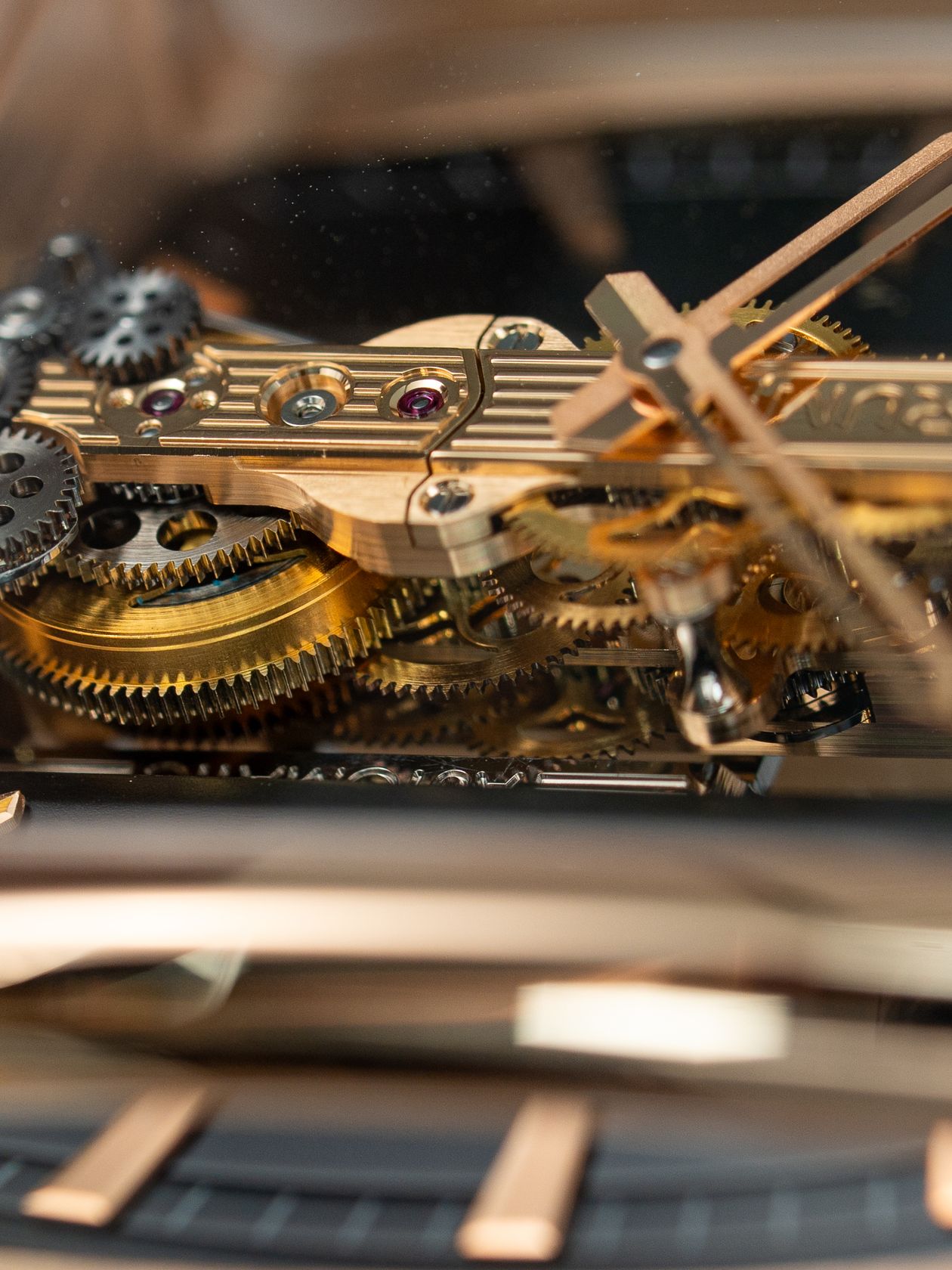 The craft the brand age inherited — and then stopped competing on. Photo: Hoàng Anh Nguyễn / Pexels
The watch that finally turned Patek's fortunes around was the hobnail calatrava — decorated with tiny pyramid-shaped spikes, otherwise basically a golden age dress watch. In 1984 the head of Patek's ad agency told Patek president Philippe Stern: make this your standard design, and I'll create an ad campaign to identify it in people's heads with your brand.
It worked spectacularly well. The resulting watch, the 3919, became known as the "banker's watch" because it became so popular among investment bankers in New York in the 80s and 90s. The ibankers bought the full mechanical story. They didn't even need self-winding mechanical watches; the 3919 was hand-wound. So be it. Patek stopped talking about quartz movements. And their sales, which had been flat since the early 70s, were by 1987 on a clear upward trajectory that has continued to this day.
The Yuppie Salvation
Obsolete technologies don't usually get adopted as ways to display wealth. Why did it happen with mechanical watches? Because the wristwatch turns out to be the perfect vehicle for it. Where better than right on your wrist, where everyone can see it?
These were the people for whom the term "yuppy" was coined. Living expensively was one of the things they were best known for. If anyone was going to adopt a new way to display wealth, it would be them. And nothing could be more legit than a gold watch. The chairman of the company was still wearing the one his wife gave him 20 years ago, before quartz watches were even a thing. If the increasing pressure to display wealth was going to emerge anywhere, this was the place.
It was critical, though, that mechanical watches were accurate enough. A new 3919 would have been off by no more than 5 seconds a day. That was nowhere near as good as quartz. Even the cheapest mass market quartz watches were accurate to half a second a day, and the best ones were accurate to 3 seconds a year. But in practice 5 seconds a day was close enough. If mechanical watches had only been accurate to a minute a day they couldn't have made the leap from keeping time to displaying wealth. It would have seemed too manifestly unluxurious to have a watch that always had the wrong time.
This is an important point about the relationship between brand and quality. Quality doesn't stop mattering when a product switches to something people buy for its brand. But the way it matters changes shape. It becomes a threshold. It no longer has to be so great that it sells the product; brand sells the product; but it does have to be good enough to maintain the brand's reputation. The brand must not break character.
Artificial Scarcity
Only three watchmakers survived the dark days of the 70s and 80s as independent companies: Patek Philippe, Audemars Piguet, and Rolex. All the rest are owned by six holding companies, which reinflated them as it became clear that mechanical watches would have a second life as luxury accessories for men.
If the time traveller walked into a Patek Philippe boutique and actually tried to buy a Nautilus, he'd get the biggest shock of all. They wouldn't sell him one. Because at Patek he'd encounter the most extreme brand age phenomenon: artificial scarcity. You can't just buy a Nautilus. You have to spend years proving your loyalty first by buying your way through multiple tiers of other models, and then spend years on a waiting list.
To push the market toward this ideal, Patek squeezes from both sides of the sale. They weed out flippers by making the path to the scarce models so costly in both time and money — so inconvenient and unreasonable — that only a genuine fan would endure it. They buy hundreds of their own watches per year on the secondary market to trace serial numbers and catch anyone reselling. When they find someone selling watches they don't want them to, they don't just cut off that customer — they cut off the retailer.
Back in the golden age the way you bought a Patek Philippe was to go to a jeweler and give them money. Now Patek is policing buyers to maintain an asset bubble. That's the business an elite watchmaker is in now.
That's what I call the comb-over effect: a series of individually small changes that takes you from something that's a little bit off to something that's freakishly wrong.
What to Do With This
The most striking thing to me about the brand age is the sheer strangeness of it. Zombie watch brands that appear to be independent and even have their own retail stores, and yet are all owned by a few holding companies. The giant, awkwardly shaped watches that reverse 500 years of progress in making them smaller. The business model that requires a company to rebuy their own watches on the secondary market to catch rogue customers. The very concept of rogue customers.
It's all so strange. And the reason it's strange is that there's no function for form to follow.
One obvious lesson is to stay away from brand. Indeed it's probably a good idea not just to avoid buying brand, but to avoid selling it too. Sure, you might be able to make money this way, but pushing people's brand buttons is just not a good problem to work on, and it's hard to do good work without a good problem.
The more subtle lesson is that fields have natural rhythms that are beyond the power of individuals to resist. Fields have golden ages and not so golden ages, and you're much more likely to do good work in a field that's on the way up.
Of course they don't call them golden ages as they're happening. "Golden age" is a term people use later, after they're over. That doesn't mean that golden ages aren't real, but rather that their participants take them for granted at the time. They don't know how good they have it.
In fact there's a single principle that will both save you from working on things like brand, and also automatically find golden ages for you.
Follow the problems.
The way to find golden ages is not to go looking for them. The way to find them — the way almost all their participants have found them historically — is by following interesting problems. If you're smart and ambitious and honest with yourself, there's no better guide than your taste in problems. Go where interesting problems are, and you'll probably find that other smart and ambitious people have turned up there too. And later they'll look back on what you did together and call it a golden age.
Read more
Subscribe to get notified when I publish new content.